Sea Stories
Send us your best sea stories using the "Contact Us" link below
The Estimating Department – Class of 1979
Mark Smith, Mark Busch, Bob Smith, Steve Van Horn, and Brian Geren have been gathering together as a group somewhere in and around the USA, every 3 to 5 years since we had graduated from USC in June 1979 (minus a few meet ups missed during the COVID Pandemic era). We are all members of the fabled (and some may label it infamous) Estimating Department – another sea story all by itself. Brian, an accomplished writer and the unofficial archivist for the ED, summed up things nicely last month:
“In August of 1975 I met some young men who would become the brothers I never had. Sure, I grew up with those in my hometown who filled that brother/sister role. I had the honor of a best friend since we were eight. But, this was different. My new brotherhood experienced the normal collegiate experiences and a whole lot more. Government sanctioned, United States Navy sanctioned, keggers and spectacular, bodacious parties. Friday night runs to Tommy’s. Then a breakfast run. Then lunch and then dinner and another midnight visit. The number of Double Chili Cheeseburgers were lost in a drunken haze. Summers spent in foreign lands making infamous names for ourselves. And of course becoming the Estimating Department. A story that would fill more than this social media post. Taco nights and the incredible legacy of Mojo Parties. Don’t get me wrong. There was much more than the Bacchanalian events of misspent youth. The day of graduation from the University of Southern California was also our commissioning as Naval Officers and our foray into a new brotherhood of protecting our great constitutional Republic.”
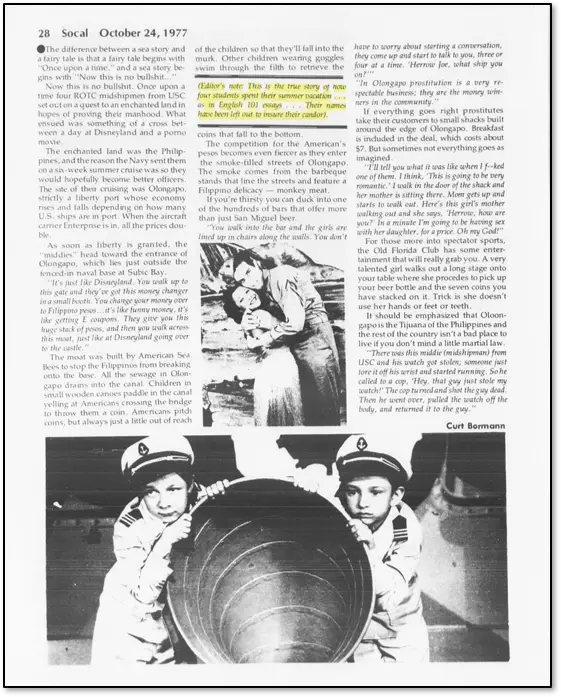
The Estimating Department brotherhood took on all aspects of, and lived, the Ballad of Subic Bay in August of 1976 (3/C Cruise) and almost caused a meltdown of the CNET staff while rampaging Italy, Sicily, Crete and Spain in August of 1978 (1/C Cruise). Let’s just say the damages to the NAS Sigonella BOQ bar and transient rooms was extensive. Our exposure to Subic Bay was documented anonymously in a Daily Trojan article that also appeared in the October 1977 edition of the DT magazine, SoCal. Here is that article.
Robert H. Bancroft ’75: Remember Pearl Harbor!
7 December 2025 – Today is the 84th anniversary of the attack on Pearl Harbor. Bear with me while I tell you the story of one young man who was there on that fateful day. His name is Robert E. Bancroft and at age 19 in 1940, he had difficulty finding a job like many young men in California. The country was still finding it tough climbing out of the depression despite huge amounts of stimulus spending by President Roosevelt. Young Bob was told you could make some money by joining the California National Guard and working in the summer of 1940 at Camp Roberts, a large army base north of Paso Robles, California. He was told at the end of the summer they would simply let you go – military service completed with some money in your pocket. Except at the end of the summer in 1940 they decided to activate his unit and now he was part of the US Army. First, he was assigned to the 251st Coast Artillery Regiment in Ventura, California, an anti-aircraft gunnery unit. Very soon thereafter they transferred his anti-aircraft unit to Pearl Harbor in November 1940. Relations we’re not going well with Japan who had already been engaged in wars with China and Southeast Asia since 1937.
Dad said it was hot and humid in Hawaii so on Saturday night December 6, 1941, he was invited on-board the USS Arizona and watched a movie outside on the main deck (no air conditioning) with many of the crew. On Sunday morning, just before 8 am he was awakened by the sound of enemy aircraft, left his tent, and started firing. His unit was 1 of 2 units on alert and ended up shooting down 2 of the 29 Japanese planes that day.
Here is an excerpt from a newspaper interview of my father – from the December 2, 1991 edition of The News Pilot, San Pedro, California: “The attack on Pearl Harbor caught a groggy Bob Bancroft off guard. Fast asleep in his bunk, Bancroft was awakened by other soldiers talking. ‘They were saying, that’s a funny-looking plane. I looked up. We decided it wasn’t ours, so we got dressed, got our weapons and started shooting.’ . . . Bancroft watched as his good friend Vernon Fairbanks, took several rounds in his torso and fell wounded . . . Bancroft, 20 at the time, saw the USS Arizona take its last gasp of air. He walked through cities stung by shrapnel and strewn with lifeless bodies. He later would fight Japanese infantrymen in fierce hand-to-hand combat. ‘I think it made men out of us . . . it challenged us.'”
Dad always had a special affection for the USS Arizona, because he was aboard her the night before the fateful attack and met some of her crew. Of the 8 battleships sunk that day, 6 would be raised, put back in operation and go on to fight in WWII. The USS Arizona took a bomb hit right near turret 2, which went down several decks and blew up her forward magazines. The horrific explosion lifted the ship out of the water, nearly broke her in half, and instantly killed 1,177 of her crew, including 23 sets of brothers and one father and son. The fire burned for several days. The flames were so hot they never found the remains of her captain except his Naval Academy ring which was melted into the steel of the bridge.
My father went on to fight the Japanese for 33 months in the Pacific. That’s a long time to be away from home. He fought with the Marines in the Solomon Islands at Guadalcanal and Bougainville in the South Pacific, some of the toughest jungle fighting imaginable.
In 1978 as a young naval officer, my ship was returning from the western Pacific after a 7½ month deployment and stopped in Pearl Harbor to refuel. Dad flew over to Pearl Harbor and rode the ship back to San Diego. While my ship was at Pearl Harbor, we had a few hours, and Dad took me around and showed me where he was during the attack (several places as they were constantly on the move). At one place near the harbor, they set up and were firing old, water-cooled machine guns at the attacking enemy planes. Being water cooled, the machine guns were constantly over-heating because they didn’t want to stop firing to let the barrels cool down. So, while 2 guys fired the machine gun, another man was running over to the harbor, filling a bucket up of salt water, running back and literally pouring the salt water over a red-hot barrel. At one point during the attack the man going to get the water wasn’t back yet, the barrel was dangerously over-heating, so his buddy stood up, dropped his pants and pissed on the red-hot barrel. I asked him how you could do that at a moment’s notice. Dad laughed and said, “You’d be surprised at what you can do when under extreme pressure!”
Dad only lived 70 years (he passed away in March 1992), and our family believes his shortened life span was a direct result of the horrific combat conditions on those South Pacific islands and the subsequent impact on his health.
If you visit Oahu, Hawaii you should visit the USS Arizona Memorial (the number 1 tourist attraction). The museum and visitors center are located on land next to the harbor and after viewing a very moving film about the attack, you take a boat over to visit the USS Arizona. The actual memorial looks like a cross as it was built over the top of the Arizona. Interestingly when you drive into the parking lot to visit the museum, most people don’t know the museum grounds and associated parking lot itself is also hallowed ground. At the end of the attack, they needed a place to lay all the recovered bodies of men and women killed during the attack on Pearl Harbor for identification. Today that ground is the museum and its parking lot.
For an overview of December 7, 1941, watch “The Black Tears of Pearl Harbor” – very good video of the attack with special emphasis on the USS Arizona. https://youtu.be/tU4H4UVbQX4
A total of 2,403 Americans were killed during the attack on Pearl Harbor. We should always remember what they died for on that fateful day.
Remember Pearl Harbor!
Robert H. Bancroft
Ted A. Blanke ’57:
After graduation, my first assignment was to go to Supply School in Athens, GA. Upon graduation, I was ordered to report to the USS KERSARGE (CV33), Aircraft Carrier to replace the Disbursing Officer. The ship was in Japan. Soon after I arrived on board and took over the office, the ship was out to sea and headed for Hong Kong. In route, we formed for a special pay day for the crew to have money for our time in Hong Kong. I had two other officers who also had money trays to help. When we were about to begin, the Sergeant at Arms had a nice line up and I had a .45 pistol on the table, we were on the Mess Deck. A hatch opened and a gust of wind came into the area, which took all the money up and out of the three trays. I grabbed the .45, chambered a round and raised my arm saying “Nobody move” – then the lights went out. When the lights came on, we dismissed everyone, swept up the money and took it back to the office to count. Not one dollar was lost.
RADM Paul Gibbons, USN ’52: Link to sea story